I took these images using a 31-cm Newtonian at f/5.6 or f/4 and an ASI1600 camera with an off-axis guider and filter wheel.
Below: Omega Centauri (NGC5139), a globular cluster which is probably the remains of a small galaxy which was mostly robbed of its stars after passing too close to the Milky Way galaxy.

Below: IC2948 using a HOO palette

Below: The galaxy M83

Below: The Trifid Nebula

Below: The Orion Nebula M42

Below: The Orion Nebula in SHO palette

Below: IC2948, an emission nebula in Centaurus. Near the centre are several Bok globules, discovered by the astronomer A. David Thackeray (and now called Thackerays globules), although no star formation has been found within them.

Below: The Lagoon Nebula.

Below: NGC3576, an emission nebula region in Carina.
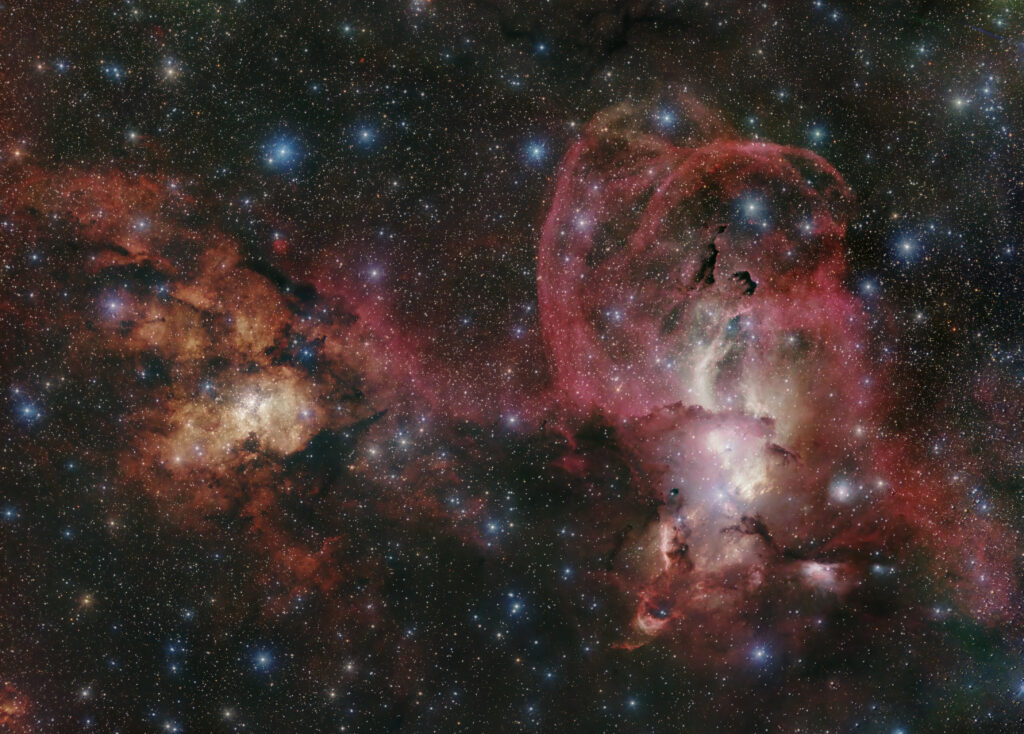
Below: The star cluster NGC6193 and the emission nebula NGC6188 in Ara.

Below: NGC6559, a complex of emission, reflection and dark nebulae.

Below: This is IC418, a planetary nebula in Lepus. I used lucky imaging to capture 9601 frames of 100 ms exposure using a 31-cm Newtonian and a 3X barlow with an ASI224MC-cool camera. I stacked these (including 1.5X drizzle) using AutoStakkert.

Below: IC5148, a planetary nebula in Grus

Below: NGC2899, a planetary nebula

Below: NGC6072, a planetary nebula.

Below: NGC3324, a large emission nebula near the etc Carina nebula.

Below: NGC2261, Hubble’s variable nebula

Below: M17, the Omega Nebula
